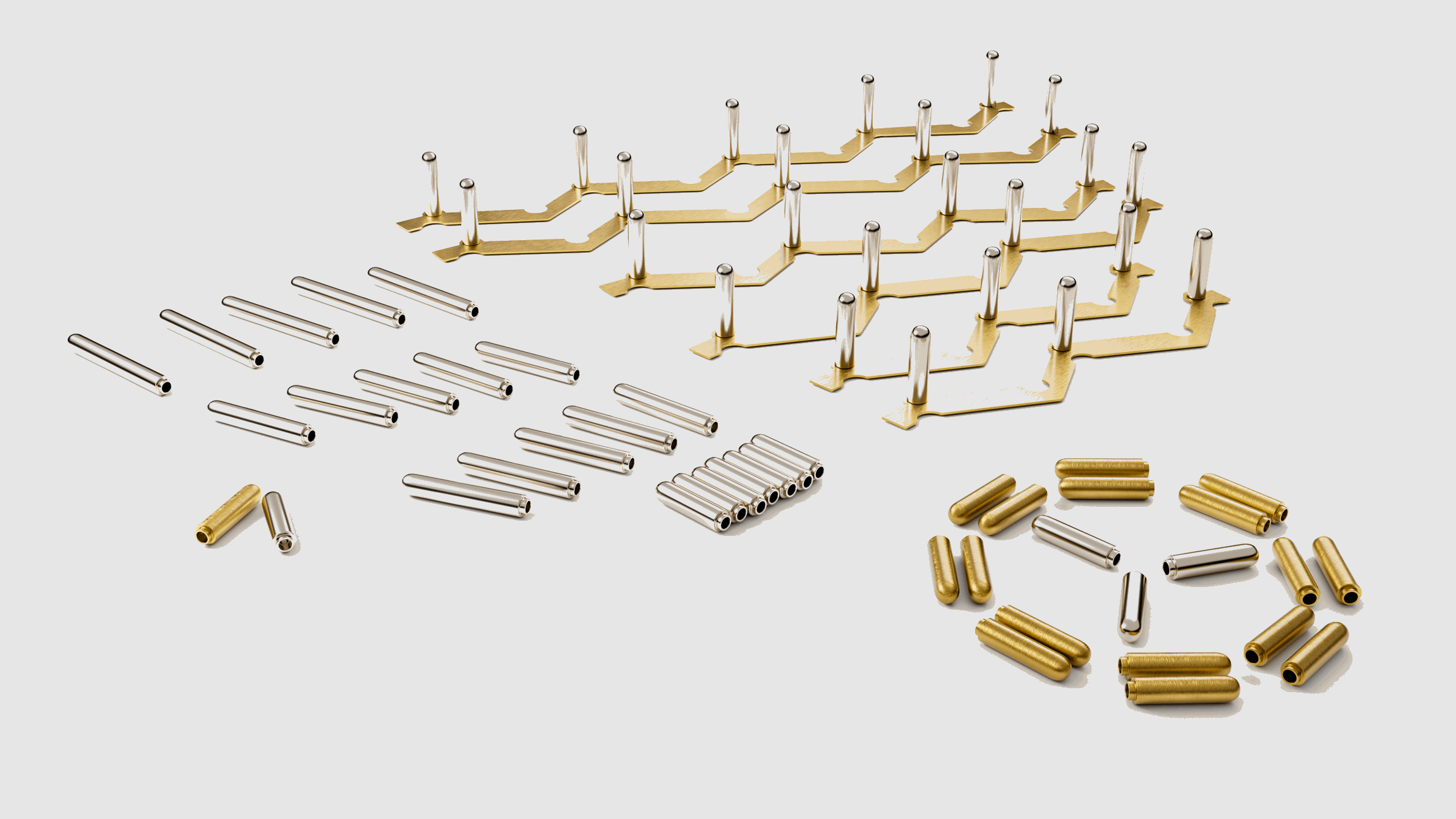
Hollow pins for sockets with grounding pin
- Classification and technical relevance
- Product video: hollow pins in use
- Function in the protective contact system
- Protective contact principle and contact mechanics
- Mechanical and thermal stress
- Materials and CuZn37
- Type E socket system and relevant markets
- System comparison: Type E and Type F
- System integration and assemblies
- Manufacturing and series integration
- Regulatory developments and low-lead solutions
- Advantages over solid pins
- FAQ about hollow pins
Classification and technical relevance
In modern electrical installation technology, reliable contact solutions are a basic requirement for safe power distribution in buildings. Socket systems not only provide the power supply, but are also part of the overall electrical protection concept. Protective contact sockets with a central grounding pin in particular place high demands on the contact parts used, as they must ensure both electrical safety and mechanical stability over long periods of use.
Hollow pins are contact components developed specifically for these applications. They provide the conductive connection to the protective earth conductor and ensure that grounding is established reliably as soon as the plug is inserted. In this way, they make a significant contribution to safely dissipating potential fault currents and supporting the operational safety of electrical installations. At the same time, they influence the mechanical insertion behavior and contact stability in everyday use.
With the increasing electrification of buildings, rising power density of electrical loads, and growing importance of compliant protective measures, structurally optimized contact parts are becoming even more relevant. Hollow pins must therefore not only meet functional requirements, but also be integrated economically into automated series production. Material selection, geometry, surface condition, and system integration all play a central role here.
In addition, materials-related and regulatory issues are becoming more important in development work. Discussions about a possible restriction of lead-containing materials, as well as growing requirements for sustainability and resource efficiency, increasingly influence the design of electrical components. Thanks to their hollow design, hollow pins offer additional degrees of freedom for optimizing mechanical properties, weight, and material usage in a targeted way.
The following sections provide a practical overview of the function, design principles, typical materials such as CuZn37, application markets, and system-related aspects of hollow pins in socket systems with a grounding pin. The goal is a practice-oriented classification of this contact component from the perspective of development, design, and industrial series manufacturing.
Product video: hollow pins in use in socket systems with a grounding pin
The product video shows typical application scenarios for hollow pins in socket systems with a grounding pin. It highlights both design details of the contact geometry and integration into electromechanical assemblies used in installation technology. This makes it easier to understand the interaction between material, forming, and contact mechanics in a practical context.
Function in the protective contact system
In Type E sockets, the hollow pin forms the conductive connection to the protective earth conductor. It ensures that the protective contact is established before the live conductors make contact. In the event of a fault, this design can provide a safe current path before live contacts become effective. This structural feature is a key element of the protective contact principle in Type E installation systems.
Beyond pure current conduction, the hollow pin also affects the mechanical behavior of the plug-in system. It helps guide the plug and ensures defined positioning at the socket interface. At the same time, its geometry influences the contact force, which in turn is critical for contact resistance, temperature rise, and long-term contact stability. In practice, the design must therefore achieve a balanced ratio between sufficient contact force and good insertion comfort.
Especially in building technology, sockets are used over many years and exposed to a wide range of stresses. Frequent insertion cycles, changing electrical loads, and varying environmental conditions place high demands on the reliability of all contact components. Hollow pins must therefore not only meet the initial functional requirements, but also maintain stable performance over the entire service life of the installation device.
Protective contact principle and contact mechanics
The protective contact principle of Type E sockets is based on axial contacting via a centrally positioned grounding pin. In contrast to systems with lateral protective contact springs, this results in a specific contact mechanism. The hollow pin must be designed so that a reliable electrical connection is created when the plug is inserted, without requiring excessively high insertion forces.
Several design factors are relevant for actual contact quality. These include wall thickness, the shape of the contact zone, surface condition, and the elasticity of the material. These parameters influence not only the electrical conductivity of the contact point, but also wear behavior during repeated plugging cycles. Insufficient coordination can lead over time to increased contact resistance or unstable contact conditions.
In industrial development projects, the complete plug-in system is therefore often considered as a functional unit. The hollow pin is not designed in isolation, but optimized in interaction with the mating contact, plastic carrier, spring concept, and assembly process. This system-level perspective is essential for achieving reproducible quality and long-term operational reliability.
Mechanical and thermal stress
Hollow pins must not only ensure electrical conductivity, but also withstand mechanical stress caused by repeated insertion cycles. In installation systems with high usage frequency, such as commercial buildings or public facilities, the number of insertion cycles can be considerable. A design optimized for the application helps maintain stable contact forces over long periods and prevents inadmissible temperature rise caused by increased contact resistance.
In addition to mechanical stress, thermal influences also affect contact pins. Temperature changes, load peaks, or elevated ambient temperatures can influence material properties. Materials such as CuZn37 provide a stable combination of electrical conductivity and mechanical strength, which can support reliable function over the entire service life of the installation device.
For long-term reliability, not only the material itself is relevant, but also how well the hollow geometry is matched to the actual stresses. This is precisely where hollow pins can show structural advantages over solid pins.
Materials and CuZn37
In practice, copper alloys are predominantly used for hollow pins. They offer a good combination of electrical conductivity and mechanical strength while also allowing economical processing. The brass alloy CuZn37 is particularly common, as it is characterized by good formability and stable mechanical properties. This makes the material suitable for drawing and forming processes typically used in the manufacture of hollow contact pins.
Typical material for hollow pins: CuZn37
One key advantage of CuZn37 is that, in many applications, the alloy can be implemented with very low lead content or in a virtually lead-free version. Against the background of current regulatory developments, this can be an important aspect in material selection. At the same time, the material provides sufficient strength to achieve stable contact forces and a defined spring effect.
The combination of a suitable alloy and an adapted hollow geometry allows both mechanical and electrical properties to be influenced in a targeted way. Additional surface treatments can further help optimize corrosion resistance, wear behavior, or contact stability. The specific design is always application-dependent and must take the respective normative requirements into account.
Type E socket system and relevant markets
Hollow pins are particularly relevant for Type E socket systems. This system operates with a centrally positioned grounding pin and is used mainly in France, Belgium, Poland, the Czech Republic, and Slovakia. It is also used in selected North African markets, for example in Morocco and Tunisia.
For manufacturers of installation devices, this means that hollow pins should not be designed only for one national application. Depending on the target market, requirements relating to the plug system, standards environment, assembly concept, and product platform may differ. As a result, the hollow pin becomes a component that must be considered internationally from both a functional and a market perspective.
The distribution of Type E systems makes hollow pins a technically relevant contact solution for internationally oriented socket programs. Especially in standardized product platforms, it makes sense to include the requirements of different markets at an early stage in the design process.
System comparison: Type E and Type F
Different protective contact systems are established within Europe. While Type E uses a central grounding pin, Type F relies on lateral protective contact springs. For manufacturers of contact parts, this means that the design of the contact components is closely linked to the respective system standard.
Hollow pins are mainly relevant wherever axial protective contacting is required. In systems with lateral contact springs, spring-type profile or stamped solutions are more common instead. This means that hollow pins are not universal plug contact parts, but highly specialized components for defined socket systems.
For international product platforms in particular, the comparison between Type E and Type F can be helpful in making system-appropriate design decisions at an early stage.
System integration and assemblies
In modern socket systems, hollow pins are often part of more complex electromechanical assemblies. They are integrated into contact carriers, combined with other contact parts, and positioned in automated assembly processes. Reproducible dimensional accuracy is just as important here as defined surface and material properties.
The quality of the individual hollow pin directly influences the functional reliability of the overall system. Even minor tolerance deviations can affect insertion comfort, contact force, or wear behavior. For this reason, in series production the hollow pin is not only a material issue, but also a process and system issue.
Manufacturing and series integration
Hollow pins are generally produced from wire or comparable semi-finished products and then brought into their final geometry through forming, drawing, and calibration processes. Dimensional accuracy, roundness, surface condition, and material structure are all critical to later performance.
In series production, hollow pins must be designed so that they can be fed, positioned, and assembled reliably in the process. This concerns not only the pure component geometry, but also the interaction with contact carriers, plastic components, and automated assembly sequences.
The quality of a hollow pin therefore does not become apparent solely in the individual part, but in the installed condition within the assembly. Only there does it become clear whether contact force, insertion behavior, and long-term stability are permanently achieved in the real product.
Regulatory developments and low-lead solutions
In the European environment, the use of lead in technical materials is increasingly being viewed critically. Existing regulatory frameworks and ongoing discussions about further restrictions on lead-containing materials are increasing the pressure to develop and implement alternative solutions.
Hollow pins can make an important contribution here. Through their geometry and the possibility of using materials such as CuZn37 with very low lead content or in virtually lead-free versions, they open up new paths for material-efficient and more regulation-resilient contact solutions. Even so, general statements about the permissibility of individual materials or applications remain dependent on the applicable framework conditions in each case.
Advantages over solid pins
Compared with solid pins, hollow pins offer several design and economic advantages that are particularly relevant in the series production of socket systems. Their hollow design makes it possible to reduce material usage in a targeted way without fundamentally compromising the functional requirements for mechanical stability or electrical conductivity. This affects not only component costs, but can also have positive effects on weight, assembly behavior, and material strategy.
A major advantage is the lower component weight. Lighter contact parts can often be handled, fed, and positioned more reliably in automated processes. This can contribute to better process stability, especially at high production volumes. At the same time, reduced material use lowers raw material demand, which can have a noticeable economic effect in large-scale production.
From a mechanical perspective as well, hollow pins open up additional design options. By specifically adjusting wall thickness and geometry, bending stiffness can be influenced by design. This makes it possible to configure hollow pins so that they provide sufficient contact force while also meeting requirements for insertion comfort and service life. With solid pins, this kind of fine-tuning is often less flexible.
Another advantage from a materials perspective is that hollow pins can often be realized with alloys such as CuZn37 using very low lead contents or in virtually lead-free versions. In light of current materials-related and regulatory developments, this is a relevant aspect. Innovative contact solutions such as hollow pins can therefore help address future requirements related to environmental compatibility and material concepts more effectively.
Overall, hollow pins are therefore not only a functional alternative to solid pins, but also an interesting optimization option from the perspective of design, purchasing, and series production. Their advantages become particularly clear where high volumes, defined insertion cycles, and economically stable manufacturing processes are required.
FAQ about hollow pins
Why are hollow pins used in sockets with a grounding pin?
They establish a reliable protective contact connection and support stable mechanical guidance during the plugging process.
Which material is commonly used for hollow pins?
CuZn37 is used in many applications because the alloy offers good formability, sufficient strength, and electrical conductivity suitable for the application.
What advantages do hollow pins offer over solid pins?
Typical advantages include lower weight, reduced material usage, design adaptability, and the possibility of low-lead or virtually lead-free material concepts.
In which markets is the Type E socket system used?
Mainly in France, Belgium, Poland, the Czech Republic, Slovakia, and selected North African markets.
Which factors are decisive in the design of hollow pins?
Key factors include contact force, insertion cycles, material, surface condition, geometry, and integration into the overall socket system.
Further technical information can be found in the knowledge section. For technical questions, it may be useful to get in touch.